
Einstein established the theoretical foundations for the laser and the maser in the paper Zur Quantentheorie der Strahlung (On the Quantum Theory of Radiation) via a re-derivation of Max Planck's law of radiation, conceptually based upon probability coefficients (Einstein coefficients) for the absorption, spontaneous emission, and stimulated emission of electromagnetic radiation.

In 1949, inspired by a question from Enrico Fermi, she proposed that inside the nucleus, protons and neutrons are arranged in a series of nucleon layers, like the layers of an onion, with neutrons and protons rotating around their axes (spinning) and the centre of the nucleus (orbiting) at each level.

The theoretical principles governing the operation of a maser were first described by Joseph Weber of the University of Maryland, College Park at the Electron Tube Research Conference in June 1952 in Ottawa.
Independently, C. Townes, J. Gordon, and H. Zeiger built the first ammonia maser at Columbia University in 1953. It used stimulated emission in a stream of energized ammonia molecules to produce amplification of microwaves at a frequency of about 24.0 GHz.
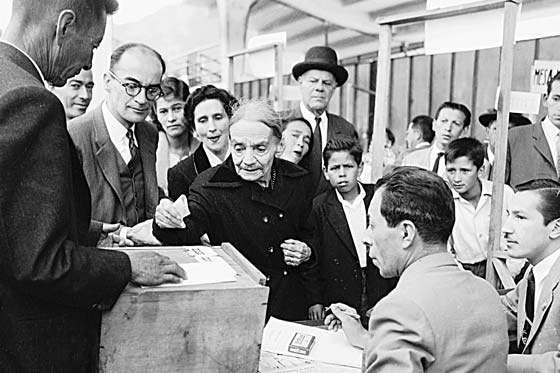
In 1947, President Miguel Alemán proposed a constitutional amendment that would let women exercise their right to participate in municipal elections.
Upon assuming the presidency, Adolfo Ruíz Cortines fulfilled his campaign promise and sent an initiative to reform Constitutional Articles 34 and 115 that promoted universal suffrage for women to the Chamber of Deputies.
However, the vote for women in Mexico was not granted until 1953.

Einstein died on April 18, 1955, at the Penn Medicine Princeton Medical Center, Plainsboro Township, New Jersey, United States.
Age: 76

Gould started to developed the idea of the laser as a grad student. In 1959 he published for the first time the word LASER.
He filed a patent application in April 1959 but the U.S. Patent Office denied his application, and awarded a patent to Bell Labs, in 1960.
Second-harmonic generation was first demonstrated by Peter Franken, A. E. Hill, C. W. Peters, and G. Weinreich at the University of Michigan, Ann Arbor, in 1961.
The demonstration was made possible by the invention of the laser, which created the required high intensity coherent light. They focused a ruby laser with a wavelength of 694 nm into a quartz sample.

For the first time, the University of Guadalajara offered a career focused on photonics, it was first offered on 2016A, it became open for everyone later that year.